
Success behind Ieoh Ming Pei
(1917-1948)
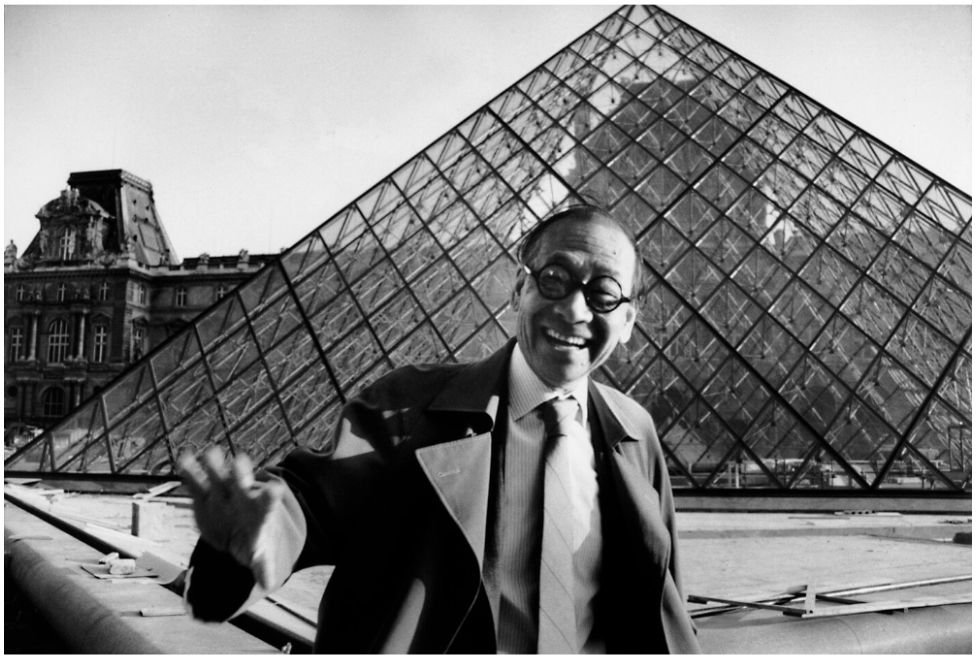
Ieoh Ming Pei was a Chinese-American architect born in Guangzhou, China, on April 26, 1917. Pei was most famously known for his projects, such as the Louvre glass pyramid, the East Building of the National Gallery of Art in Washington, D.C., and the John F. Kennedy Presidential Library and Museum. Growing up, he and his family moved to Hong Kong and then to Shanghai, all before the age of 10. Then, at the age of 18, Pei moved to the United States and initially enrolled at the University of Pennsylvania before transferring to the Massachusetts Institute of Technology, graduating in 1939 with a Bachelor of Architecture. In 1938, while visiting a friend in New York City, he met Eileen Loo, whom he married and had four children with. Although Pei and Loo planned to return to China after their marriage, they were unable to do so due to the outbreak of World War II. Thus, Pei carried out several architectural contracts around the United States. From 1945 to 1948, he worked as an assistant professor at the Graduate School of Design of Harvard University, and eventually received a Master of Architecture from that school.
(1948-2019)
In 1948, Pei joined the firm of Webb & Knapp as a director of the architectural division. He also worked closely with the real estate developer William Zeckendorf, head of the firm, and created urban projects, such as the Mile High Center in Denver, the Hyde Park Redevelopment in Chicago, and the Place Ville-Marie in Montreal. Only in 1954 did Pei become a U.S. citizen, for which he considered himself “very, very lucky” because “in those days, to be an American citizen was very, very difficult.” In 1955, he founded his own architectural firm, I.M. Pei & Associates. The firm designed architecture ranging from the Luce Memorial Chapel in Taiwan to the Emerson Museum of Art, Syracuse, New York. In 1960, Pei was selected to design the multi-airline terminal at John F. Kennedy International Airport, New York City. Besides designing public buildings, Pei was also involved in urban renewal planning, such as the Javits Convention Center in 1986. In 1989, he was chosen by Francois Mitterrand, a former president of France, to renovate the Louvre Museum, which is known as the Grand Louvre Project. At the same time, Pei completed the Bank of China Tower in Hong Kong, designed to resemble bamboo. Although he retired in 1999, he still pursued architectural projects until he died in 2019.
